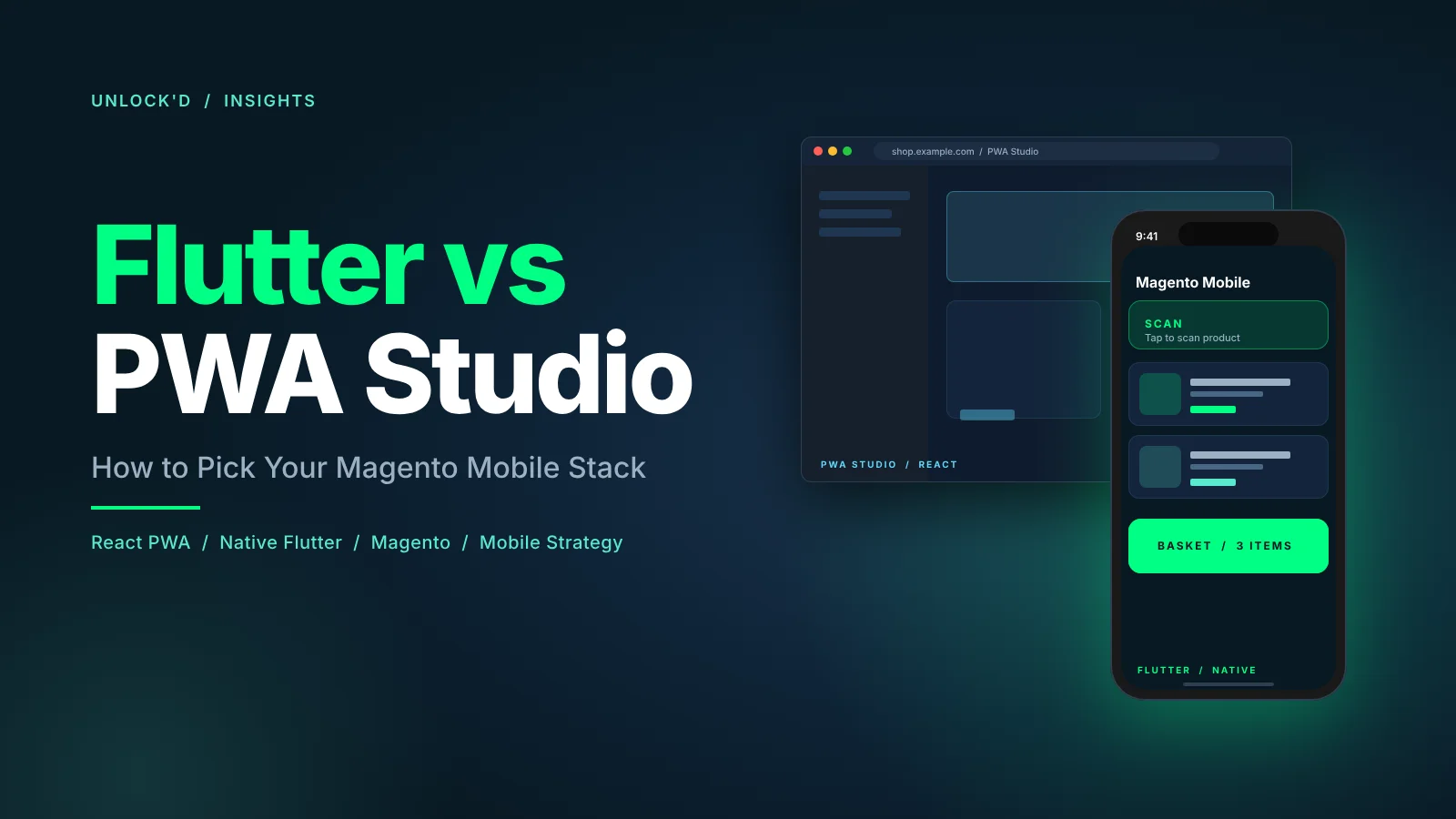

Two questions get bundled together when Magento teams ask about mobile. The first is whether to invest in a mobile experience at all. The second is whether that experience should be a progressive web app (built with Adobe’s own PWA Studio) or a native app (usually Flutter, sometimes React Native).
Those are very different conversations, and most of the confusion comes from treating them as one. This piece is about the second. If you’ve already decided mobile matters, here’s how we help Magento teams pick between PWA Studio and Flutter without spending six months regretting the call.
What you’re actually picking between
PWA Studio ships a React-based storefront that runs in the browser and optionally installs as a progressive web app on supported platforms. Flutter ships a native app compiled from Dart, distributed through the App Store and Play Store, talking to the same Magento backend over REST or GraphQL.
Both talk to the same Magento. The question isn’t which one “works with Magento”. Both do. The question is where you want the presentation layer to live, and what device-level capabilities your users actually need.
PWA Studio extends your web channel with app-like behaviour. Flutter gives you a real native app on top of the same Magento backend. The choice is about users and capabilities, not about which technology talks to Magento. They both do.
The architectural split
A PWA Studio app is a React storefront with a service worker in front of it. It loads as a web page, caches shell assets, talks to Magento through GraphQL, and can be installed to the home screen on Android and (with caveats) iOS. It runs in the browser’s rendering pipeline and gets the same capabilities any modern web page gets.
A Flutter app is a compiled binary on the user’s phone. It paints the UI with its own engine (Skia, migrating to Impeller), calls Magento through REST or GraphQL, and has direct access to the camera, Bluetooth, filesystem, background tasks, and every other platform API that apps get and web pages don’t.
The important bit in that diagram is the shared Magento APIs. Whichever front-end you pick, your commerce logic doesn’t change. You aren’t buying a second backend. You’re picking a presentation layer.
When PWA Studio is the right call
PWA Studio makes sense for a specific kind of team and a specific kind of user:
- Your team is already staffed in React and JavaScript, and you want one web codebase rather than a separate mobile team.
- Your app is mostly about browsing and checkout on a phone, with no hardware integrations, serious offline demands, or native feature requirements.
- You want fast iteration: ship a change to the web and it’s live instantly, no app store review.
- Your content team lives in Magento and PageBuilder, and you want their edits to appear on mobile without a separate CMS or release cycle.
- You’re targeting consumers, not field users or B2B professionals working in tough conditions.
In that profile, PWA Studio is still a reasonable pick. You get a mobile experience that feels closer to an app than a normal responsive site, you keep one codebase, and you avoid the cost and overhead of app store distribution. The trade-off is that you never really leave the browser, with everything that implies.
When Flutter is the right call
Flutter wins once the app has to do things the browser can’t do well, or when multi-platform reach matters:
- Scan-to-order and barcode-heavy workflows. Camera access, fast scanning, keyboard-style scanner support, and offline queues all work reliably in a native app. In a browser they work sometimes and break often.
- BLE, NFC, or hardware integrations. Web Bluetooth exists but coverage is uneven and limited. Flutter has a mature BLE ecosystem used in production.
- Serious offline behaviour. Service workers give you caching; they don’t give you reliable background sync, queued writes, or a local database that survives a day in a warehouse with patchy wifi.
- App store presence. If your customers expect to find you in the App Store or Play Store, a PWA doesn’t fill that gap on iOS meaningfully, and only partially on Android.
- Push notifications that actually fire. Native push on iOS and Android is solved. PWA push is still patchy on iOS and inconsistent across browsers.
- Multi-platform reach. If your roadmap touches desktop (Windows, macOS, Linux) or embedded devices, Flutter ships there from the same codebase. PWA Studio doesn’t.
B2B apps for field sales, construction supply, healthcare, warehousing, and logistics land on the Flutter side almost every time. Consumer browsing apps land more in the middle, with PWA Studio often good enough.
Side by side
Neither column is “better”. They describe different products with different reach.
Team, hiring, and developer experience
This part of the decision gets skipped too often. Both stacks need people who know what they’re doing.
PWA Studio fits teams who already ship React for the web and want to reuse skills. The reality in 2026 is that PWA Studio’s community is smaller than React’s general community, so you’ll hire React developers and onboard them to Magento-specific GraphQL shapes, Venia’s architecture, and PageBuilder integration. Senior PWA Studio specialists are rarer than senior React generalists.
Flutter is a separate skillset, and that’s both a cost and a benefit. You need Flutter engineers, not React ones. On the other hand, Flutter’s hiring pool has grown steadily for five years, it’s actively backed by Google, the ecosystem is deeper for hardware and performance work, and the code is more consistent across projects because the framework is more opinionated.
If you already have a strong React team and a small mobile ambition, PWA Studio lowers your hiring pressure. If mobile is strategic and you expect the app to do things beyond a browser, Flutter is a separate investment that pays off over years.
Timeline and lock-in
Teams often assume PWA Studio is faster because “it’s just a website”. That’s true for the first deploy. It’s rarely true for the first version that actually ships to customers and holds up in production.
Our rough ranges, for a typical mid-size Magento 2 instance:
- PWA Studio greenfield: 3 to 6 months to a credible mobile storefront, depending on how much of Venia you keep and how much you theme. Longer if you need deep B2B customisation, punchout, or heavy performance work.
- Flutter scan-to-order MVP: about 6 weeks using our reusable scanner module, connected via Magento APIs. That’s a vertical slice, not a full storefront.
- Flutter full storefront: 3 to 5 months, depending on catalogue depth, B2B features, and how much of the Magento PageBuilder content you want to represent natively vs. open as web views.
On lock-in, both stacks are better than they look. Magento is the system of record either way, so the cost of switching front-ends later is real but contained: you rebuild the presentation layer, not the commerce backend. That cuts both ways. A team that ships PWA Studio today can add Flutter for scan-to-order later without throwing anything away, and a Flutter-only team can add a web storefront (PWA Studio or otherwise) when consumer browsing becomes a priority.
When teams switch, and which direction
We mostly see the switch go one way. Teams that started with PWA Studio and then added field, warehouse, or B2B workflows reach the edges of what a browser can do and start a Flutter project alongside it. The PWA stays live for marketing and consumer browsing. Flutter takes the workflows the browser can’t handle cleanly.
The other direction does exist. Teams that invested in a native app for every customer-facing surface sometimes find they’d rather push most consumer traffic to a well-themed web storefront and keep Flutter for the workflows that truly need it. In that case, PWA Studio or a lighter headless front-end takes over the marketing and checkout path.
Our take
We ship Flutter against Magento for most B2B, field, and hardware-connected use cases, including Santens’ scan-to-order app for construction professionals. We’ll happily recommend PWA Studio for teams with a pure React staffing profile and a pure consumer browsing ambition. The honest failure mode on either side is the same: picking the stack that matches your team’s comfort instead of your users’ job.
If you’re staring at a mobile roadmap for Magento and it isn’t obvious which side of the line you’re on, the decision usually becomes clear in one 30-minute conversation once we know what your users actually do on a phone.
Practical next steps
- Start from users, not from stack. What is the one workflow the app has to nail in year one? Scan, browse, reorder, pay, notify? The answer almost always picks the stack.
- Test the native-feature list honestly. If hardware scanners, offline queues, or reliable push matter even a little, PWA Studio will push back against you later.
- Keep Magento authoritative either way. Whatever front-end you pick, commerce logic stays in Magento. That’s the main thing you’re protecting.
- Don’t confuse “our team knows X” with “X fits our users”. Hiring is solvable. Mobile product-market fit in the wrong stack is a rewrite.
For the Flutter side of the picture, see our Flutter Magento integration guide and our e-commerce development services.
Picking between PWA Studio and Flutter for your Magento mobile app? Book a 30 min call and we'll tell you which side fits your users and your team.